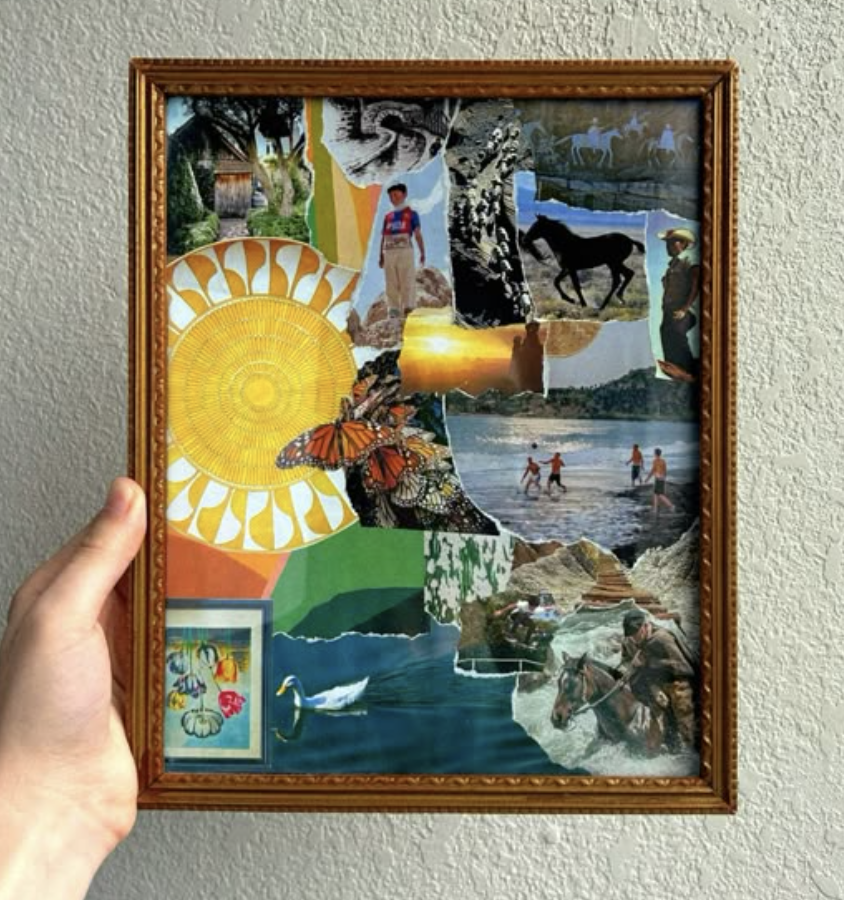
This week in Time Away, Together – my six month experience to find or create work you love – we’re all taking an Artist Date. It’s my favorite week of the program.
Popularized by Julia Cameron, author of The Artist’s Way, Artist Dates are dedicated time to unplug and nurture your creativity. In the Time Away version, we add that it can also be time to nurture your relationship with nature.
Here’s what it does and why it matters —
Much of our time – in the US – is spent in answering, deciding, optimizing, and achieving mode. We spend shockingly little time exploring our creative interests, or really slowing down to observe and commune with nature.
The impact is a life that feels full, busy, and sometimes a little dry and uninspired. It can even make us wonder if this is all there is. It’s the epitome of all work and no play.
Counterintuitively, all this focused effort doesn’t necessarily lead to the best outputs. Doing something like an Artist Date naturally creates the conditions for inspiration to shine through. For example:
- Marily Oppezzo and Daniel Schwartz at Stanford found that people generated significantly more creative ideas walking vs sitting.
- Injecting novelty into our lives supports flexible thinking, the ability to see LOTS of solutions.
- Awe – that WOWWWWW feeling you get staring out at a beautiful vista – slows rumination, fuels creative thinking and calms our nervous system.
Exercises like Artist Dates are fundamental to the Time Away experience. The transformation, big ideas, and joy come from breaking with our norms, getting out of our day-to-day and truly slowing down to enjoy life’s simpler pleasures. Giving ourselves this time is also an act of self-love, showing us we matter enough to plan a special experience for.
Here’s how to do one – they are so life-enhancing! I hope you’ll try it.
Give yourself some advanced notice. I ask the group a month in advance to block out 2-3 hours. It’s more realistic to find this block of time if you plan for it a few weeks out.
Consider if there’s anything you’ve been wanting to do lately. A ceramics class, a new restaurant, even just a fiction book you’ve been wanting to get lost in. It doesn’t have to be elaborate. Check the list below for ideas to get you started.
Try and go alone if you can. The idea is to have a little quiet time and space, to let yourself rest and digest.
Keep it as a real commitment on your calendar. Sometimes, it can be easy to book over time we’ve allotted for ourselves. You could experiment with expecting that a voice will pop in suggesting it is not a good idea to take a few hours to do this. Try overriding it when it comes up and notice how you feel after the Artist Date.
A few date ideas to get your motor running –
- Wander through a botanical garden, tide pool, local trail, or unfamiliar neighborhood with your phone tucked away.
- Visit an art museum, small gallery, open studio, historic home, used bookstore, or library section you never visit.
- Go to a fabric, bead, stationery, flower, or art-supply store with no intention of buying anything.
- Sit in a café and watch the world go by, people watch, sip a tea slowly and journal for a bit or flip through a local paper.
- See a matinee, live music performance, dance class, comedy show, poetry reading, or community theater production.
Want to see how ours go? Time Away is on Instagram now! Find me @timeawaycoach, and get a run down of the dates we did. I’ll also be sharing behind-the-scenes on It Won’t Love You Back: Creating Connection in a Tech Addicted World, co-written with Dr. Thekla B. Ross there too. We’re so excited about how the book is coming together!
Hope to see you all soon.
Kit
Sources: Oppezzo & Schwartz (2014), “Give Your Ideas Some Legs,” Journal of Experimental Psychology · Sio & Ormerod (2009), “Does Incubation Enhance Problem Solving?”, Psychological Bulletin. Julia Cameron, The Artist’s Way;Ritter et al. (2012), · “Diversifying experiences enhance cognitive flexibility,” Journal of Experimental Social Psychology

